What is AOD 9604?
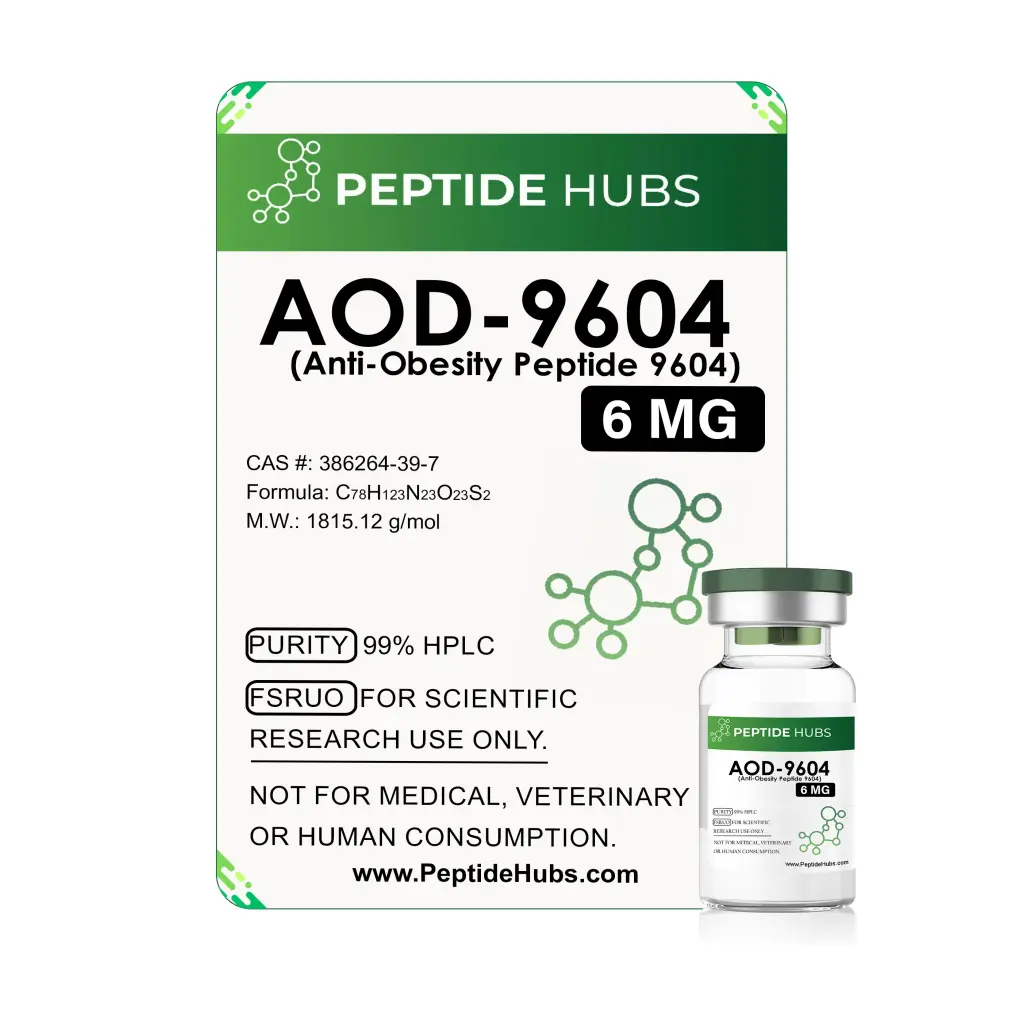
AOD 9604 is a synthetic hexadecapeptide derived from the C-terminal region of human growth hormone. FDA describes AOD 9604 free base as a 16-amino-acid peptide made from the 177-191 fragment of hGH with an added tyrosine at the N-terminal end and a disulfide bridge between two cysteine residues.
AOD 9604 was developed by Metabolic Pharmaceuticals Limited as an anti-obesity drug candidate. The original idea was to isolate the fat-metabolism signal of growth hormone while avoiding the growth-promoting, IGF-1-raising, and insulin-resistance concerns linked with full-length HGH.
How does AOD 9604 work in lipid-metabolism research?
AOD 9604 is researched for lipolysis and lipid-metabolism signaling, not for appetite suppression. In mouse studies, AOD 9604 reduced body-weight gain, increased fat oxidation, increased plasma glycerol as a lipolysis marker, and did not compete for the human growth hormone receptor or induce hGH-receptor cell proliferation.
The beta-3 adrenergic receptor connection is specific and should not be overstated. A 2001 mouse and beta-3 receptor knockout study reported that AOD 9604 increased beta-3 adrenergic receptor RNA expression and lipolytic sensitivity, but concluded that AOD 9604's lipolytic actions were not mediated directly through beta-3 adrenergic receptors.
The IGF-1 distinction is one reason AOD 9604 is different from HGH. The human safety summary of six AOD 9604 trials reported no significant IGF-1 increase, no glucose-tolerance worsening, and no anti-AOD 9604 antibodies detected in the tested subjects, but those safety observations do not prove meaningful human fat loss.
Does AOD 9604 have human trial data?
AOD 9604 has human trial exposure, but the human obesity program did not support drug approval. The Stier 2013 safety paper describes six double-blind, placebo-controlled AOD 9604 trials run from 2001 to 2006 with 893 participants, including two longer obesity studies called METAOD005 and METAOD006.
The larger 24-week METAOD006 trial enrolled 534 people and randomized 502 adults with obesity to placebo or oral AOD 9604 at 0.25mg, 0.5mg, or 1mg daily. FDA's 2024 review concluded that most reviewed AOD 9604 studies failed to show weight-reduction benefit versus placebo and that the lack of effectiveness evidence weighed against adding AOD 9604 free base or acetate to the 503A Bulks List.
Is AOD 9604 the same as HGH?
AOD 9604 is not the same as full-length human growth hormone. HGH is a 191-amino-acid hormone with growth hormone receptor activity and downstream IGF-1 effects, while AOD 9604 is a short modified fragment designed to study the lipid-metabolism region without the full hormone's growth-promoting activity.
AOD 9604 should be compared with other hGH-fragment and GH-axis topics before it is compared with modern weight-loss drugs. The closest educational comparisons are full HGH, hGH 176-191 fragment, Tesamorelin, and other GH-axis compounds, not Semaglutide, Tirzepatide, Retatrutide, or Cagrilintide.
AOD 9604 vs HGH, hGH 176-191, and GLP-1 drugs
| Comparison |
What it is |
Main pathway |
Why the distinction matters |
| AOD 9604 |
Modified hGH 177-191 fragment with added N-terminal tyrosine |
Lipid-metabolism and lipolysis research; beta-3 adrenergic receptor expression studied in animals |
AOD 9604 is a fragment research peptide with no FDA-approved obesity indication. |
| hGH 176-191 |
Common name for the C-terminal growth hormone fragment category |
Lipolytic-region research tied to the tail of human growth hormone |
Vendors often blur hGH 176-191 and AOD 9604, but AOD 9604 is the tyrosine-modified analogue with its own identity records. |
| Full HGH |
Full 191-amino-acid human growth hormone |
Growth hormone receptor signaling and IGF-1-mediated effects |
HGH has growth-promoting and glucose-metabolism implications that AOD 9604 was designed to avoid. |
| Semaglutide and Tirzepatide |
Approved active ingredients in specific prescription medicines |
GLP-1 or GIP/GLP-1 incretin receptor signaling |
These drugs reduce appetite and affect glucose regulation through receptors unrelated to AOD 9604's hGH-fragment mechanism. |
| Cagrilintide and Retatrutide |
Newer metabolic drug-development compounds |
Amylin, incretin, glucagon, or multi-receptor metabolic signaling |
These compounds belong in an incretin or amylin comparison cluster, not an hGH-fragment cluster. |
Is AOD 9604 legal?
AOD 9604 legal status depends on country, product form, marketing claims, and whether the user is subject to sport anti-doping rules. In the United States, FDA has not approved an AOD 9604 drug product, FDA identified no USP or National Formulary monograph for AOD 9604 free base or acetate, and the Pharmacy Compounding Advisory Committee voted 0 yes and 12 no on December 4, 2024, when asked whether AOD 9604 free base and AOD 9604 acetate should be placed on the 503A Bulks List.
FDA's current compounded-peptide safety discussion names AOD 9604 among nominated-but-withdrawn bulk drug substances that may pose immunogenicity and impurity-characterization risks for certain routes of administration. FDA also states that it has no, or only limited, safety-related information for AOD 9604 and lacks enough information to know whether compounded AOD 9604 would cause harm when administered to humans.
For tested athletes, AOD 9604 is a prohibited substance. The WADA 2026 Prohibited List names growth hormone fragments, including AOD-9604 and hGH 176-191, under section S2.2.3 and marks the S2 class as prohibited at all times in and out of competition.
In Australia, the Therapeutic Goods (Poisons Standard - June 2026) instrument lists AOD-9604 by CAS number 221231-10-3 among poisons for which possession without authority is illegal. Buyers should check local law before purchase because AOD 9604 status is not uniform across jurisdictions.
What side effects and safety issues are known for AOD 9604?
The best human safety summary for AOD 9604 is limited but more concrete than most research-peptide marketing. Stier 2013 reported 893 participants across six trials, no treatment-related serious adverse events, no drug-related withdrawals, no clinically significant ECG or laboratory changes, no meaningful IGF-1 rise, no glucose-tolerance worsening, and no anti-AOD 9604 antibodies in tested serum samples.
FDA's 2024 compounding review gives a more cautious regulatory reading. FDA cited limited clinical safety information, no human information for proposed subcutaneous and transdermal use, possible adverse events including diarrhea, chest tightness, euphoria, and cancers with unclear causality, and immunogenicity concerns tied to peptide aggregates, impurities, formulation, concentration, and storage conditions.
How should AOD 9604 5mg be stored and handled?
Unreconstituted AOD 9604 5mg should stay sealed, dry, protected from light, and temperature controlled. FDA's 2024 review cited supplier stability information for AOD 9604 free base at -18 C for 3 years, 0-7 C for 1 year, and 7-30 C for half a year, while also noting that long-term storage information from a certificate of analysis pointed to tight vials in a freezer.
AOD 9604 acetate may have different storage requirements than AOD 9604 free base. FDA's review cited AOD 9604 acetate storage at -20 C for longer storage, with some certificate-of-analysis language using 2-8 C for less than 6 months and -20 C for more than 6 months.
For reconstitution, the first rule is to follow the product label, certificate of analysis, and lab protocol for the exact vial form. Sterile water for injection or bacteriostatic water should only be used when the label or protocol states compatibility; after reconstitution, use aseptic handling, refrigerate at 2-8 C, protect from light, avoid repeated freeze-thaw cycles, and discard any vial that shows cloudiness, discoloration, precipitate, particles, seal damage, or uncertain storage history.
No universal post-reconstitution shelf life can be stated for every AOD 9604 5mg vial. A responsible lab sets a short internal beyond-use window from validated stability data, preservative status, sterility controls, and the product label rather than copying a generic peptide timeline.
What quality checks matter before buying AOD 9604 5mg?
Peptide Hubs AOD 9604 5mg should be evaluated by identity, salt form, sequence, vial strength, lot number, certificate of analysis, storage history, and sterility-related testing when a sterile format is claimed. FDA specifically noted public-domain and supplier inconsistencies around AOD 9604 CAS numbers, structures, formulas, impurity controls, aggregate controls, microbial testing, and bacterial endotoxin testing.
A credible AOD 9604 listing should name the compound as AOD 9604, explain the hGH-fragment identity, separate the product from GLP-1 drugs, avoid dramatic fat-loss claims, and disclose that the human obesity program did not establish an approved treatment. Claims that AOD 9604 is "clinically proven fat loss" without the failed obesity endpoint are incomplete.
Why do bodybuilders search for AOD 9604?
Bodybuilders search for AOD 9604 because the compound is marketed around fat metabolism, cutting phases, and body-composition research. The evidence-aware answer is narrower: AOD 9604 belongs in hGH-fragment and lipid-metabolism research, not anabolic steroid use, not muscle gain, not GLP-1 appetite control, and not guaranteed contest-prep outcomes.
Competitive athletes should treat AOD 9604 as a doping risk. WADA names AOD 9604 directly as a prohibited growth hormone fragment, so sport status is a separate issue from consumer drug approval or research-supply claims.