


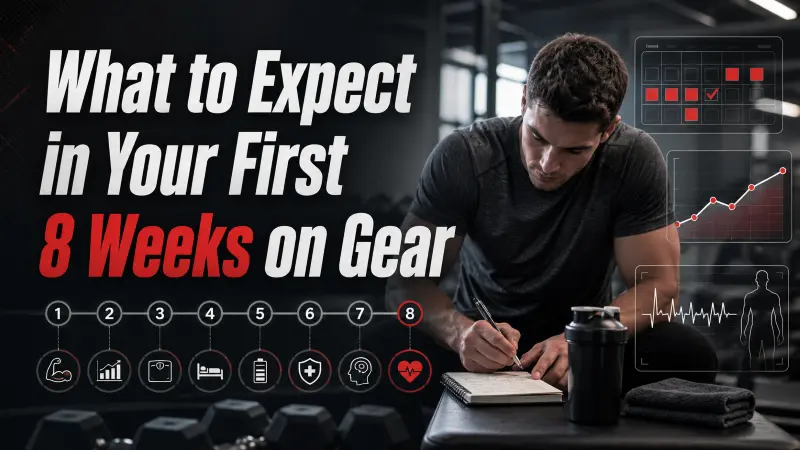
What to Expect in Your First 8 Weeks on Gear
Important note: This article is educational and harm-reduction focused. It does not provide steroid cycle instructions, dose recommendations, compound selection advice, injection schedules, post-cycle therapy instructions, or medical advice. Anabolic-androgenic steroid misuse can carry serious health, fertility, cardiovascular, hormonal, psychiatric, liver, kidney, and legal risks. Anyone using or considering anabolic steroids should speak honestly with a qualified healthcare professional.
Introduction
Beginners often search for a simple steroid timeline because they want to know when the results will start.
They want to know what happens in week 1, when strength goes up, when the scale moves, when the mirror changes, and when they should feel like the cycle is "working." That curiosity is understandable. But it can also be misleading, because the first 8 weeks on gear are not just a results timeline. They are also a risk timeline.
Some people notice early changes in training drive, pumps, appetite, body weight, or confidence. Others notice very little at first. Some see visible changes quickly, but much of that early size may be water, glycogen, food volume, or temporary fullness rather than permanent muscle tissue. Some people feel better. Some feel anxious, irritable, bloated, sleepless, or uncomfortable before they ever see the result they hoped for.
The point of this article is not to tell anyone how to run a first steroid cycle. It is to explain what beginners often expect, what may actually happen, which signs are easy to misread, and which warning signs should never be ignored.
Important Disclaimer: This Is Not a Cycle Plan
This article does not provide instructions for using anabolic steroids. It does not discuss what to take, how much to take, how often to take it, how long to take it, how to inject, or how to manage post-cycle therapy.
That boundary matters because a timeline can easily become a hidden instruction manual if it is written carelessly. A beginner reading about the first 8 weeks may be tempted to compare themselves against a fixed schedule and make reactive changes if their experience does not match. That is exactly the wrong mindset.
A safer way to read this article is as a set of expectations and warning signs. It helps answer questions like:
- Why are early results sometimes misleading?
- Why can side effects appear before impressive visual changes?
- Why does blood pressure matter even if someone feels fine?
- Why should bloodwork not wait until everything is over?
- Why is adding more compounds midstream a common beginner mistake?
Anabolic steroid misuse is not legal or safe, and nonmedical use may involve much higher exposure than medical use. It also links misuse with health problems such as high blood pressure, cholesterol changes, heart problems, liver disease, kidney damage, mood changes, infertility, testicular shrinkage, and withdrawal symptoms.
Why "8 Weeks" Is Not a Universal Steroid Timeline
The phrase "first 8 weeks" sounds precise, but steroid timelines are not universal.
Different compounds behave differently. Oral and injectable steroids may be noticed differently. Shorter-acting and longer-acting preparations can create different timing patterns. Individual response also varies by genetics, baseline hormone levels, training experience, diet, sleep, stress, body fat, health history, and whether the product is accurately labeled.
Two beginners can do the same thing and report completely different experiences. One may feel stronger early. Another may mainly feel bloated. One may see acne quickly. Another may not. One may sleep better at first. Another may feel wired and restless. One may gain weight rapidly. Another may barely move on the scale because food intake is not aligned with training.
That is why rigid week-by-week promises are not reliable. They create false certainty.
Instead of asking, "What should happen by week 4?" a better question is, "What is changing, how am I measuring it, and are any health markers moving in the wrong direction?"
Before Week 1: What Should Already Be in Place
The most important part of the first 8 weeks happens before week 1 starts.
A beginner who starts without preparation is already behind. Steroids can change the body quickly, but they do not create structure. If training, nutrition, sleep, health monitoring, and medical honesty are missing, the early weeks can become a mess of guesswork.
Before any nonmedical steroid use is even considered, a person should understand the risks and speak with a healthcare professional. They should also have a clear view of their current health, not just their current physique.
Useful preparation areas include:
- Baseline bloodwork to understand hormone and health markers before anything changes
- Blood pressure tracking, because blood pressure can rise quietly
- A consistent training plan with clear progression, not random hard workouts
- Nutrition targets that support the goal without reckless overeating
- Sleep consistency, because poor sleep can distort mood, recovery, appetite, and blood pressure
- A record of current medications, supplements, health conditions, and family risk factors
- A plan for contacting a healthcare professional if warning signs appear
Anabolic steroids can affect cholesterol, blood pressure, heart and blood flow, mood, liver health, tendon risk, fertility, and more. That is why preparation cannot be limited to gym numbers and progress photos. Read about most common steroid cycle mistakes and how to avoid it.
Week 1: Expectations vs Reality
Week 1 is where beginners often expect too much too soon.
Some people expect dramatic strength, rapid muscle gain, and a completely different feeling in the gym almost immediately. But early changes can be subtle, inconsistent, or mostly psychological. A person may feel more motivated simply because they believe the cycle has started. They may train harder because they are paying closer attention. They may eat more because they are trying to "make the most of it." Those changes can affect performance before the drug itself is the main driver.
Early physical changes may also be easy to misread. A fuller look can come from increased carbohydrates, sodium, water, glycogen, or harder training. A small scale jump can be food volume or water. A better pump does not automatically mean new muscle tissue has been built.
Week 1 can also bring anxiety. Some beginners become hyper-aware of every sensation: a headache, a mood shift, a change in libido, a skin change, a sleep disruption. That does not mean every feeling is dangerous, but it does mean the person should not rely on guesswork or forum reassurance.
Good week 1 thinking is calm and observational. Do not chase dramatic changes. Do not add anything because results are not instant. Do not ignore basic health markers just because the mirror has not changed yet.
Weeks 2-3: Early Performance and Side Effect Signals
Weeks 2 and 3 are often when beginners start watching themselves more closely.
Some may notice changes in training performance, pump, appetite, libido, confidence, recovery perception, or body weight. Others may still feel like not much is happening. That variation is normal because compound type, individual response, food intake, training quality, sleep, and product quality all matter.
This is also when early side effects may start getting harder to dismiss. Acne, oily skin, irritability, mood swings, sleep changes, increased sweating, water retention, breast tenderness, libido changes, headaches, or higher blood pressure can all become part of the picture.
The mistake is treating every early change as either proof of success or something to casually manage alone. A beginner may think stronger pumps mean everything is going perfectly. Another may panic at water retention and start trying to "fix estrogen" without bloodwork or medical guidance. Both reactions can create problems.
Useful things to watch during this phase include:
- Blood pressure trends, not just single readings
- Sleep quality and whether waking up feels harder
- Mood changes that other people are noticing
- Acne or skin changes that are rapidly worsening
- Breast tenderness, swelling, or unusual sensitivity
- Headaches, chest discomfort, shortness of breath, or unusual swelling
- Training performance compared with planned progression, not ego lifting
Weeks 4-5: When Results May Become More Noticeable
By weeks 4 and 5, some beginners may feel that the cycle is finally becoming obvious.
Training loads may move up. Recovery may feel easier. Muscles may look fuller. The scale may be higher. Gym confidence may increase. For many people, this is the exciting part because the effort finally seems to be showing.
It is also one of the easiest points to make bad decisions.
When results become noticeable, beginners may start pushing harder than their connective tissue can tolerate. Muscles may feel ready before tendons and joints are prepared for the extra load. Anabolic steroid use may increase the risk of tendon problems, including swollen or torn tendons.
Another problem is reckless eating. Some beginners assume that more food always means more muscle. But fast weight gain can also mean fat gain, water retention, worsening blood pressure, poorer conditioning, and a less clear picture of what is actually improving.
Weeks 4 and 5 should be treated as a checkpoint, not a green light to escalate. The better questions are:
- Is strength improving in a planned, controlled way?
- Is body weight rising at a reasonable pace?
- Is waist size changing faster than expected?
- Is blood pressure still acceptable?
- Is sleep stable?
- Are side effects manageable, worsening, or being ignored?
- Would bloodwork show the same positive story the mirror seems to show?
The mirror can be motivating, but it is not a health assessment.
Weeks 6-8: The Point Where Beginners Often Get Overconfident
Weeks 6 through 8 can be the overconfidence zone.
If things are going well, the beginner may start believing they have figured everything out. If things are not going well, they may start looking for quick fixes. Both paths can lead to bad decisions.
Common overconfidence patterns include adding another compound, increasing exposure, extending the plan, ignoring bloodwork, skipping blood pressure checks, training recklessly, or treating side effects as the price of progress. Some beginners also become emotionally attached to the new look and start worrying about losing it before the cycle is even over.
This is where the mental side becomes important. Feeling stronger can change how someone trains. Looking fuller can change how someone sees themselves. Getting compliments can make it harder to think clearly. A person may become more willing to accept risk because the results finally feel real.
That is exactly when discipline matters most. If you planned for a tesosterone only cycle then it's mandatory to stick to your plan.
Weeks 6 through 8 should not be treated as permission to get sloppy. They should be treated as the period where monitoring, restraint, and honesty become even more important.
What Results Are Actually Worth Tracking
Beginners often track the wrong things.
The scale matters, but it is not enough. The mirror matters, but lighting, pump, water, posing, and confidence can distort perception. Strength matters, but reckless strength increases can raise injury risk if technique and tissue tolerance are ignored.
A better tracking system looks at performance, body composition signals, health markers, and behavior together.
Useful things to track include:
- Strength progression across planned lifts
- Body weight trend across multiple days, not one weigh-in
- Waist measurement
- Progress photos under consistent lighting and conditions
- Blood pressure
- Sleep quality
- Mood stability
- Cardio fitness or conditioning
- Appetite and digestion
- Acne, hair shedding, breast tenderness, or other side effects
- Bloodwork when guided by a healthcare professional
The goal is not to obsess over every tiny change. The goal is to avoid being fooled by one exciting marker while several important ones are getting worse.
For example, a person might gain weight and strength while blood pressure rises and sleep gets worse. That is not a simple success story. It is a mixed signal. A good tracking system makes those mixed signals harder to ignore.
What Is Mostly Water, Glycogen, or Temporary Fullness?
One of the most confusing parts of a first steroid timeline is early size gain.
Beginners may look bigger quickly and assume they have built large amounts of new muscle tissue. Some muscle gain may occur over time, especially if training and nutrition are consistent. But early changes can also come from water retention, glycogen storage, increased food intake, inflammation from harder training, or better pumps.
This matters because temporary fullness can disappear quickly. A beginner who mistakes all early size for permanent tissue may panic later when body weight drops or the look changes. That panic can lead to poor decisions, including jumping into another cycle too soon or adding compounds to hold onto a temporary appearance.
Better interpretation means asking:
- Did waist size increase along with body weight?
- Did strength improve in a way that matches the training plan?
- Are progress photos improving without relying on pump or lighting?
- Is conditioning getting worse?
- Are blood pressure and sleep still stable?
- How much of the change remains after the temporary fullness fades?
Not every pound gained during the first 8 weeks is quality muscle. That is not a negative message. It is a realistic one.
Red Flags During the First 8 Weeks
Some side effects should not be normalized as part of the process.
Red flags during the first 8 weeks include:
- Chest pain
- Shortness of breath
- Fainting
- Severe headaches
- Very high blood pressure
- Yellowing of the skin or eyes
- Dark or discolored urine
- Severe abdominal pain
- One-sided leg swelling, warmth, or pain
- Sudden weakness, numbness, confusion, or speech difficulty
- Severe mood swings
- Severe depression
- Suicidal thoughts
These are not problems to troubleshoot through comment sections. They are medical warning signs. If symptoms are severe, sudden, or frightening, urgent medical care is the right move.
The Mental Side: Confidence, Irritability, and Risk-Taking
The first 8 weeks are not only physical.
Some beginners feel more confident, driven, and assertive. That can feel positive at first. But the same period may also bring irritability, impatience, anxiety, poor sleep, emotional reactivity, or risk-taking. Sometimes the user notices it. Sometimes friends, partners, family, or training partners notice it first.
Anabolic steroid misuse is linked with mood changes such as irritability and aggressive behavior, and also notes withdrawal symptoms after stopping, including fatigue, restlessness, sleep problems, decreased sex drive, cravings, and depression.
The mental side can also involve body image pressure. A beginner may start comparing every workout, photo, and weigh-in to the enhanced version of themselves. If progress slows, they may feel tempted to escalate. If side effects appear, they may minimize them because they do not want to lose momentum.
That is why emotional monitoring matters. A person should pay attention to:
- Arguments or irritability becoming more frequent
- Sleep getting worse
- Training decisions becoming more reckless
- Anxiety about losing size or strength
- Feeling unable to stop despite side effects
- Depressive symptoms or thoughts of self-harm
Physical progress is not worth losing emotional stability. If mood changes become severe, medical help should come before gym goals.
Why Bloodwork Should Not Wait Until the End
Many beginners think bloodwork is something to do after a cycle. That misses the point.
Bloodwork at the end can show where someone landed, but it may not catch problems early enough. If cholesterol, hematocrit, liver markers, kidney markers, hormones, or other values are moving in the wrong direction, waiting until everything is over may mean the person spent weeks ignoring a developing issue.
Blood pressure is similar. It should not be checked only when symptoms appear. High blood pressure can be silent, and anabolic steroid misuse is linked with cardiovascular risk factors.
A healthcare professional may consider monitoring areas such as:
- Complete blood count, including hematocrit
- Lipid panel, including HDL and LDL cholesterol
- Liver markers such as ALT and AST
- Kidney markers such as creatinine and eGFR
- Total testosterone and free testosterone
- LH and FSH
- Estradiol
- Blood pressure
- Other markers based on health history and clinician judgment
This is not a self-treatment checklist. It is a reminder that feelings and mirror changes are not enough. A person can look better while health markers worsen.
The Endocrine Society notes that anabolic-androgenic steroid use can suppress the body's testosterone-producing system, and that withdrawal after extended high-dose use can involve sexual dysfunction, fatigue, depressed mood, and sometimes serious depression or suicidality. Recovery may take months or even years after prolonged highly supraphysiologic exposure.
Common First-8-Weeks Mistakes
The first 8 weeks can teach a beginner a lot, but only if they avoid the usual traps.
Common mistakes include:
- Expecting instant results and getting impatient in week 1
- Eating recklessly because the scale is treated as the only progress marker
- Ignoring blood pressure because there are no obvious symptoms
- Adding compounds midstream because results are slower than expected
- Training beyond connective tissue tolerance because strength is rising
- Treating side effects based on forum advice instead of medical guidance
- Confusing water weight and glycogen fullness with permanent muscle gain
- Skipping bloodwork until after problems appear
- Using unverified products and trusting labels too easily
- Having no exit plan for recovery, mood, libido, and health markers after use stops
The pattern behind all of these beginner steroid cycle mistakes is the same: reacting emotionally instead of monitoring carefully.
A beginner does not need more bravado. They need fewer variables, better health tracking, and enough patience to avoid changing the plan every time the mirror or scale creates a new emotion.
What Happens After Week 8?
Week 8 is not the end of the story.
Some beginners think the main risk is what happens while they are actively using steroids. But what happens afterward can be just as important. Natural testosterone production may be suppressed. Mood can drop. Libido can change. Sleep may suffer. Strength and body weight may decrease. The enhanced look may fade. Anxiety about losing progress can push people toward another cycle too soon.
Anabolic steroids can lead to withdrawal symptoms after stopping, including fatigue, restlessness, loss of appetite, sleep problems, decreased sex drive, steroid cravings, and depression that can sometimes become serious.
This is why an "8-week results" mindset is incomplete. Results during the cycle are only one part of the outcome. A more honest evaluation asks what remains after the temporary effects fade and whether health, mood, fertility, hormones, and habits are still in a good place.
This article does not provide post-cycle therapy instructions. Recovery should not be improvised from comment sections, and medications used after steroid cycles should not be treated like a guaranteed reset. Medical supervision matters.
Final Thoughts
The first 8 weeks on gear are often described as a results timeline, but beginners should think of them as a response timeline.
The body may respond with strength, fullness, confidence, and scale weight. It may also respond with blood pressure changes, cholesterol shifts, acne, mood changes, sleep problems, estrogen-related symptoms, liver stress, or early signs that something is wrong. A good-looking mirror check does not cancel out a bad health marker.
The safest lesson is not "expect this exact result by this exact week." It is that results vary, early size can be misleading, side effects deserve attention, and the urge to escalate is one of the biggest beginner traps.
If someone is going to study this topic, they should study it with patience and honesty. The first 8 weeks should not be about chasing the most dramatic transformation possible. They should be about understanding response, staying disciplined, monitoring health, and not letting early progress overpower good judgment.
External Sources Used
MedlinePlus - Anabolic Steroids
Mayo Clinic - Performance-Enhancing Drugs: Know the Risks
Endocrine Society Clinical Practice Guideline - Testosterone Therapy in Men With Hypogonadism
Articles

Testosterone Hormone: The base of all steroids To understand the mechanism of action of Anabolic Steroids in general and in bodybuilding in particular, we need to know what the hormone testosterone is and how it acts inside the human body. Pretty much any ana…

Pay securely with Bitcoin (BTC) 1. Introduction & Key Benefits Thank you for choosing to pay with Bitcoin! We're excited to offer a fast, secure, and global way to complete your purchase. Lower Fees — Avoid traditional credit card processing fees. Enhanced Pr…

What is Testosterone. It's Importance and Function. Before we talk about anabolic steroids in general, it's important to figure out what testosterone is to make this piece of article as helpful source of information as possible for those taking pharmaceutical…
Customers Feedbacks
Please leave your feedback on products or service below.
Thank you beforehand.
- Pretty easy to find what I was looking, and clear concise intructions were given, Can\'t imagine you could make it any easier.
- Everything is very easy to find.